Tuesday, September 30, 2014

Blog Post #7

After thinking about how technology is being used in the classroom as a universal tool I decided that it was a good thing, but maybe not the best thing for my future career. I think there are only a few students in this class that are pursuing Physical Ed. and I am one of them. The reason I say technology would'nt be best is because I want children to stray away from sitting in front of a computer or their phone screen for long periods of time and actually get their hands "dirty" with other activities. I do not totally disagree with the use of technology in the classroom because I do think it is beneficial, but I also think teachers need to maintain boundaries and a balance of technology. This will be one of my weaknesses when I become a teacher: knowing that they are receiving technology based instruction in their other classes will be hard for me to incorporate it in my instruction as well. I guess I could say that my goal with my students would be to clarify the appropriate times to use technology and the times when technology should be put down and entertainment/education be sought after in another fashion. On the other hand, I do have a great deal of experience with technology and I would certainly be able to use it in instruction. For example, music counts as technology and music could be used many times in a P.E. curriculum to teach content standards. Another example would be showing demonstration videos, methods like these would be beneficial to those students known as "visual learners." I found these two You Tube videos as examples. 1. Demonstrations 2. Instructions

With all of that being said, I want my readers to know that I am a very open-minded person and I can learn something and understand it's meaning from anything I can wrap my head around. For example, Bennett's video on audio recordings and QR codes-that was really interesting! I've always wondered how companies make those codes and why they are important. Bennett expressed that a code can hold anything you want it to and that the use of QR codes is very beneficial for sharing the child's work/progress with the parent. What a neat way to communicate information! Tuck's Kindergarten class also learned something very useful: iPad Reading in a Center. With the iPad, the student was able to hear his self while simultaneously evaluating his self. This reading technique, along with her Poplet app tutorial, seemed to be great tool for self evaluation. The next topic, Alabama Virtual Library (AVL) is something that I am familiar with. I am so glad students are learning basic research skills at such a young age. These skills will allow them to be so much more dependent and not to rely on somebody else finding the answer. AVL is also a great way to teach children to identify specific concepts/subjects and learn new facts. The Build a Board project was also a very interesting app to use in the classroom. Using a board builder in Discovery Ed. teaches students great techniques for organization, sorting information, note taking, and creativity. It also seems like a super fun way for them to share their work with the class! Lastly, I wanted to make a comment on the video "We All Become Learners." Dr. Strange is right every time he says it, "Teachers will never know everything there is to know about everything!" Teachers will teach the students and the students will sometimes have the opportunity to teach the teacher, and I believe this will always be accurate.
Toddler learning letters on an iPad app.

Friday, September 26, 2014

Project #6: C4K Summary #1


Comic book style comment.
This week for comment #3 I was assigned to a student named Andrew who is part of Mrs. Greer's 5th grade class. Here is the class blog, you can find the students on the right hand side.
The post I commented on was tagged "100 word challenge," and he did a great job getting exactly 100 words into his post. He described a scenario about his family leaving their house to catch a plane. I enjoyed picturing his vivid sentences of what happened right before they left the house. Like I said, he did a great job with this portion of the post. On the other hand, I had to agree with the comment that Mrs. Greer left him pointing out his lack of quotation marks. I assumed they had learned this grammar rule by reading her comment about it. I reinforced this correction he needed to make in my comment as well. Quotation marks are vital when it comes to telling a story and having people in that story say specific things. Being in 5th grade he will begin to write many more narrative essays and this part of grammar is something that needs to become a habit.
The second student I had was named Cheyenne, and I believe she was about the same grade as Andrew. I remember her post being short, sweet, and to the point in answering her teacher's request. She shared her feelings about having an anti-bullying group come speak to her class-she enjoyed what they had to say. I shared with her that I liked reading her post and agreed with her because I believe bullying is a very serious problem in all school systems. The only correction I gave her was not to forget her proper nouns that required a capital letter, her school's name for example.
The first student I was assigned to was a young girl in New Zealand. I commented on one of her posts that included a Google slideshow. She made this presentation by using each letter of the alphabet and relating each letter to a sport. I remember she made a wonderful presentation that was very detailed with the names of the sports and graphics to go with them. I think that she enjoyed making this presentation because there was so much effort put into it.

Wednesday, September 24, 2014

Blog Post #6

Anthony Capps shared many important concepts and useful examples to understand how beneficial Project Based Learning (PBL) is in a classroom. He has shown 3rd graders how to use iMovie and his success proves that the PBL method works! The first two movies we were asked to watch, Part 1 and Part 2, shared the importance on how PBL should be implemented in the classroom.

~ Make sure the project includes the state content standards (Capp's example included Reading, Writing, and Social Studies).
~ And make sure the state content standards are represented in the project's standard/requirements.
~ Try to establish a project that the students can relate to/engage in (family, culture, leisure activities).
~ Include peer revision or even peer selection of the best work.

The first two points are pretty obvious why they are important to PBL, but the last two are the ones I want to focus on. When a teacher introduces a project the student thinks one of two thoughts: "I really don't want to do this." or "This might actually be fun." Our goal as educators is to create something so the student will enjoy learning. When the student can actively engage in the learning process and relate what they are studying to their own life that is when they are learning and retaining the most. Secondly, students also have the opportunity to learn when they critique their classmate's work. Every student will have a different opinion or idea about the subject, and by reviewing peer work the students are learning to be observant, open-minded, and maybe a little unbiased. I believe that when students acquire these skills they create the potential to expand their knowledge on any subject.
Capps opened my mind to what it takes to be a successful educator from PBL, to using iCurio, to establishing discovery education in the classroom as well. I want to share one of my favorite quotes from his commentary, "Never limit your students...give them the opportunity to exceed your expectations." This stood out to me when he said this because for so long children have been confined to a very small box that only accepts the correct answer from the text book; but now with methods such as PBL and Discovery Ed. the children can produce many different, and correct, answers.
puzzle pieces

Friday, September 19, 2014

Project #7: My Sentence Videos

I recorded myself with my DELL laptop. I then downloaded those recordings to a MAC desktop, that is why I ended up with this watermark over my videos.

My Sentence


My Passion

Tuesday, September 16, 2014

Blog Post #5

I swear I'm learning something new in this class every day! And what a great start to becoming a lifelong learner.

I had never heard of a Personal Learning Network (PLN) before today and it seems very helpful for an educator in the new technology-based learning generation. A Personal Learning Network is somebody's personalized space dedicated to their professional relationships, research sources, and commonly used tools/gadgets to help them in their research. The sites such as Netvibes and Symbaloo contain many tools to help someone begin a PLN (I think that Symbaloo would be a better choice for a beginner). Through these sites, one can gather as many contacts and online sources as they can and add them to their page. Whether they need an answer immediately, or they want to save research for later, the data will always be there. A PLN is an ongoing project; it can always be modified by the user and that's what is so helpful about it. By exploring the links shared by Dr. Strange for this blog post, I learned that a PLN is never finished and it is never perfect. Our personal relationships shrink and grow all the time; and for teachers it's always best to communicate with others that share your same beliefs and values about education. In some cases, it could also be helpful to get a different/opposing opinion about something, so a variety of sources is crucial.
This You Tube video is a great introduction for learning more about what a PLN is all about and how to create your own. Thinking ahead, if I were to make a PLN for myself I would include some Physical Education/Health teachers that have made a difference in their community because that is my personal goal. By collaborating with somebody who shares the same goals the possibilities are endless!
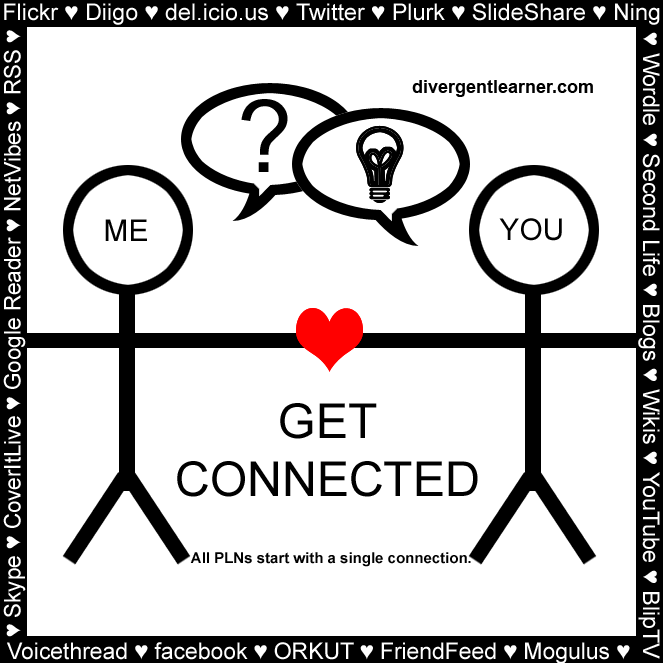
A conncetion between two people.